
Buddhism is often described as a science of the mind—a contemplative tradition that offers a systematic understanding of how the mind works and how it can be trained to cultivate greater wisdom, compassion, and lasting well-being. Over centuries, generations of practitioners have explored these teachings through direct experience, arriving at remarkably consistent insights into the nature of the mind and the causes of happiness and suffering.
In recent decades, advances in neuroscience have made it possible to study the effects of Buddhist meditation in the laboratory. Research involving both experienced meditators and beginners has shown that these practices can produce measurable changes in the brain, influencing attention, emotional regulation, compassion, and overall well-being. While science and Buddhism approach the mind from different perspectives, many contemporary findings echo insights that Buddhist practitioners have developed for centuries.
In this talk, we will explore what neuroscience is revealing about Buddhist meditation, examine some of the practices that have been the focus of scientific research, and discuss what these discoveries can teach us about cultivating a healthier, happier, and more resilient mind in everyday life.
Book recommendation from Marina & Hans: Altered Traits: Science Reveals How Meditation Changes Your Mind, Brain, and Body by Daniel Goleman and neuroscientist Richard J. Davidson.
Buddhist Mind Science, creators Marina Brucet and Hans Burghardt. Available as a self-paced self-study online course for those who cannot participate in-person at an FPMT center.

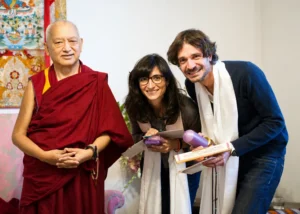
Marina Brucet Vinyals holds a BA and a MA in Biochemistry and a PhD in Molecular Biology in Immunology from the University of Barcelona, where she also performed postdoctoral studies. After this, she decided to change research in the laboratory for research of the mind and its possibilities. To this aim, she completed a six-year full-time study program Masters Program of Advanced Buddhist Studies of Sutra and Tantra at Lama Tzong Khapa Institute, Italy. She studied with great Tibetan lamas such as His Holiness the Dalai Lama, Lama Zopa Rinpoche, Lama Jampa Monlam and Khensur Jampa Tegchok, amongst others, and has completed a one-year individual meditation retreat, among others. Presently, she combines continual development and meditation retreats with teaching meditation and Buddhist philosophy, at both general and specialized levels, with an approach that always takes into account the context and circumstances of Western life. She mainly teaches at Tushita Meditation Center Spain and other FPMT centers, and collaborates with SEE Learning (Emory University) in Spain.

Hans Burghardt holds a BA and a MA in Biochemistry and Molecular Biology and a PhD from the University of Barcelona, where he spent seven years doing research. Since 2002, he meditates and is a student of great Buddhist masters including His Holiness the Dalai Lama, Kyabje Lama Zopa Rinpoche, Kirti Tsenshab Rinpoche, Lama Jampa Monlam, Khensur Jampa Tegchok amongst others. He has completed the Masters Program of Advanced Buddhist Studies of Sutra and Tantra at Istituto Lama Tzong Khapa (Italy) and has completed a one-year individual meditation retreat. He currently teaches meditation and Buddhism at Tushita Meditation Center Spain and other FPMT centers, and is co-founder and coordinator of the Initiative for an Emotional, Ethical, and Social Education, that promotes the establishment of Emory University’s SEE Learning in Spain.